Lower back pain in amateur athletes: when it's muscular and when to see a doctor
Learn to distinguish self-limiting mechanical low back pain from lumbar pain that requires urgent medical assessment, with clear clinical criteria and management guidelines based on evidence.
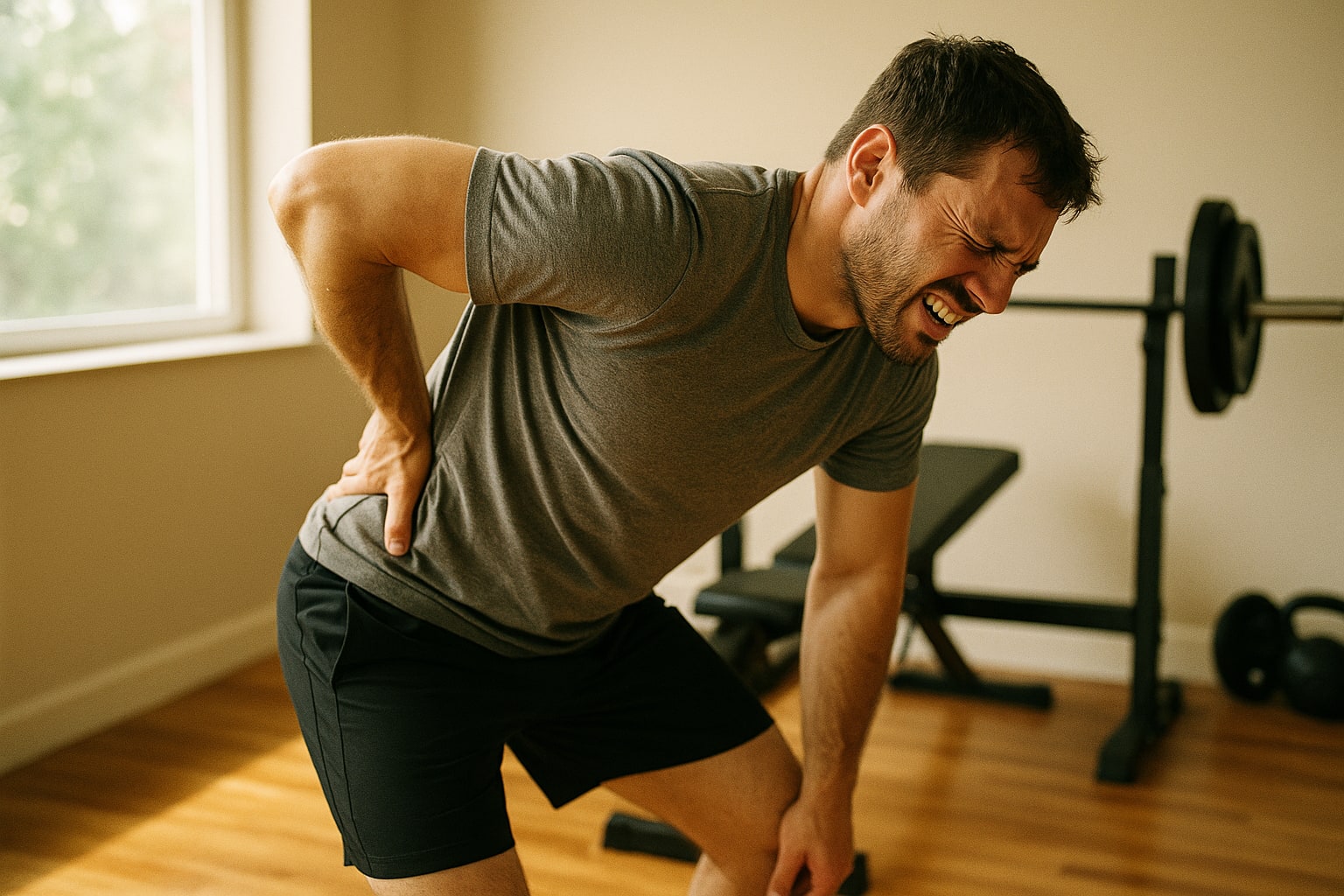
You woke up with a tight back after yesterday’s workout. It hurts when you bend down, pulls a little when you twist, but you can walk. Is this normal? Should you rest? Should you see a doctor? This is a common doubt among those of us who train for fun and don’t want to be either overly cautious or reckless.
This article is aimed at amateur athletes (runners, gym-goers, cyclists, padel or futsal players) with recent or recurring low back pain. It is not a guide to complex chronic low back pain, nor does it replace an assessment by a professional. It will, however, give you concrete criteria to decide what to do over the next 24-72 hours.
Why low back pain is so common in amateur athletes
Low back pain affects 70-85% of adults at some point in life (Hoy et al., Best Practice & Research Clinical Rheumatology, 2010). Among amateur athletes the percentage is similar, but with a nuance: we tend to combine a sedentary job with load spikes on weekends. That mix is a perfect breeding ground for strains and muscle overload.
Most episodes are mechanical and non-specific: there is no particular structure damaged, but rather an overload of the muscular, fascial and joint system in the area. The good news is that 90% resolve within 4-6 weeks with conservative management (Qaseem et al., Annals of Internal Medicine, 2017).
Mechanical-muscular low back pain: how to recognize it
These are the typical features of benign post-workout low back pain:
- Localized pain in the lower back, with no radiation below the knee.
- Worsens with specific movements (bending forward, twisting) and improves with relative rest.
- Appears hours or 1-2 days later after a demanding workout (squats, deadlifts, long run, intense match).
- No tingling, no loss of strength, no fever.
- You can walk, although with discomfort.
If your condition fits here, it is most likely a muscle strain or overload that is self-limiting.
Initial management in the first 72 hours
- Gentle movement, not complete rest. Walk 20-30 minutes several times a day.
- Local heat for 15-20 minutes, 2-3 times a day (more useful than cold for non-traumatic muscle pain).
- Analgesia if you need it: paracetamol or NSAIDs at usual doses, following the leaflet instructions.
- Avoid maximal loads for 5-7 days, but maintain light activity (easy cycling, swimming, walking).
- No bed rest beyond 24-48 hours: it worsens the prognosis (solid evidence in NICE and ACP guidelines).
Warning signs: when to see a doctor, no question about it
This is where it’s worth being strict. Red flags (red flags in the clinical literature) are signs that require medical assessment, sometimes urgently. Go to emergency services or request a priority appointment if any of these appears:
- Pain radiating below the knee§h85× to the foot, especially if it is intense.
- Tingling, numbness or loss of strength in one leg (your leg gives way when climbing stairs, you drag your foot).
- Loss of bladder or bowel control or saddle anaesthesia (numbness in the genital and perianal area). This is an emergency: possible cauda equina syndrome.
- Fever associated with low back pain.
- Intense night pain that doesn’t ease in any position.
- Significant previous trauma (a hard fall, an accident).
- Unexplained weight loss or cancer history.
- Pain that doesn’t improve at all after 4-6 weeks of proper conservative management.
These red flags are not alarmism: they are included in the clinical guidelines of most medical societies (NICE 2020, ACP 2017).
Specific conditions frequent in amateur athletes
Low back pain from strength training overload
Typical after deadlift, squat or rowing sessions with questionable technique or high volume. It is usually purely muscular, improving in 3-7 days. Review technique and load progression before lifting heavy again.
Low back pain in runners
Common on long runs or when you increase volume abruptly. It is often associated with weakness of the gluteus medius and core. A good warm-up before running and respecting the +10% weekly rule help prevent it.
Sciatica
Pain that runs down the back of the thigh and leg, sometimes with tingling. It may be due to nerve root irritation (a disc herniation, for example). It requires medical assessment, although many improve with conservative treatment in 6-12 weeks.
Evidence-based prevention
What does work, according to systematic reviews (Steffens et al., JAMA Internal Medicine, 2016):
- Regular combined exercise: strength + aerobic work. It reduces the risk of recurrence by up to 35%.
- Core strengthening: planks, bird-dog, dead bug. 2-3 sessions per week, 10-15 minutes.
- Gradual load progression: don’t increase weight or volume by more than 10% per week.
- Hip mobility: hip stiffness transfers load to the lumbar area.
- Lifting technique: if you do deadlifts or squats, invest in 2-3 sessions with a qualified coach.
What does not have solid evidence as primary prevention: lumbar belts, specific insoles, “orthopaedic” mattresses.
Common mistakes when managing low back pain
- Prolonged absolute rest. It worsens the prognosis. Move, even if slowly.
- Returning to 100% the day after the pain stops. Reintroduce load progressively over 1-2 weeks.
- Self-medicating with corticosteroids or muscle relaxants without prescription. They are not harmless.
- Ignoring red flags because “it’s surely nothing”. Cauda equina syndrome has a short treatment window.
- Stretching aggressively an acute area. In the inflammatory phase it can worsen. Gentle mobility is better.
Contraindications and special groups
- Pregnancy: low back pain is common but should always be assessed by your midwife or gynaecologist.
- Diagnosed osteoporosis: any low back pain after exertion requires ruling out a vertebral fracture.
- History of cancer: lower the threshold for consulting.
- Under 20 or over 55 with a first episode: guidelines recommend earlier medical assessment.
What to do tomorrow
- Self-assess with the red flag list. If there is any, book an appointment today.
- If there are no red flags, plan 5-7 days of reduced load: walk, easy swimming, avoid maximal lifts.
- Set aside 10 minutes for basic core work: front plank 3×30 s, bird-dog 3×8 per side, glute bridge 3×12. Start once the acute pain subsides.
Frequently asked questions
How long should low back pain last before I worry?
If after 4-6 weeks it has not substantially improved despite proper conservative management, see a doctor. Sooner if any red flag appears.
Can I keep training with mild low back pain?
Yes, with adaptation. Reduce loads by 40-60%, avoid movements that reproduce the pain and maintain low-impact aerobic activity. Controlled movement promotes recovery.
Is an MRI useful to diagnose my low back pain?
In most non-specific low back pain it provides no useful information and can generate incidental findings (protrusions, degeneration) that also exist in people without pain. It is only indicated for red flags or prolonged lack of improvement.
Is cold or heat better for low back pain?
For non-traumatic muscle pain, heat usually relieves more (it improves circulation and reduces spasm). Cold makes sense in the first 24-48 hours if there is a clear traumatic component.
Can I do squats and deadlifts if I have recurrent episodes?
Yes, with correct technique, appropriate progression and a strengthened core. In fact, strength training reduces relapses. What doesn’t work is avoiding loading your back for life out of fear.