Dynamic vs static stretching: when to use each
An evidence-based practical guide to knowing when to do dynamic stretching and when to do static stretching, with concrete examples for before and after training.
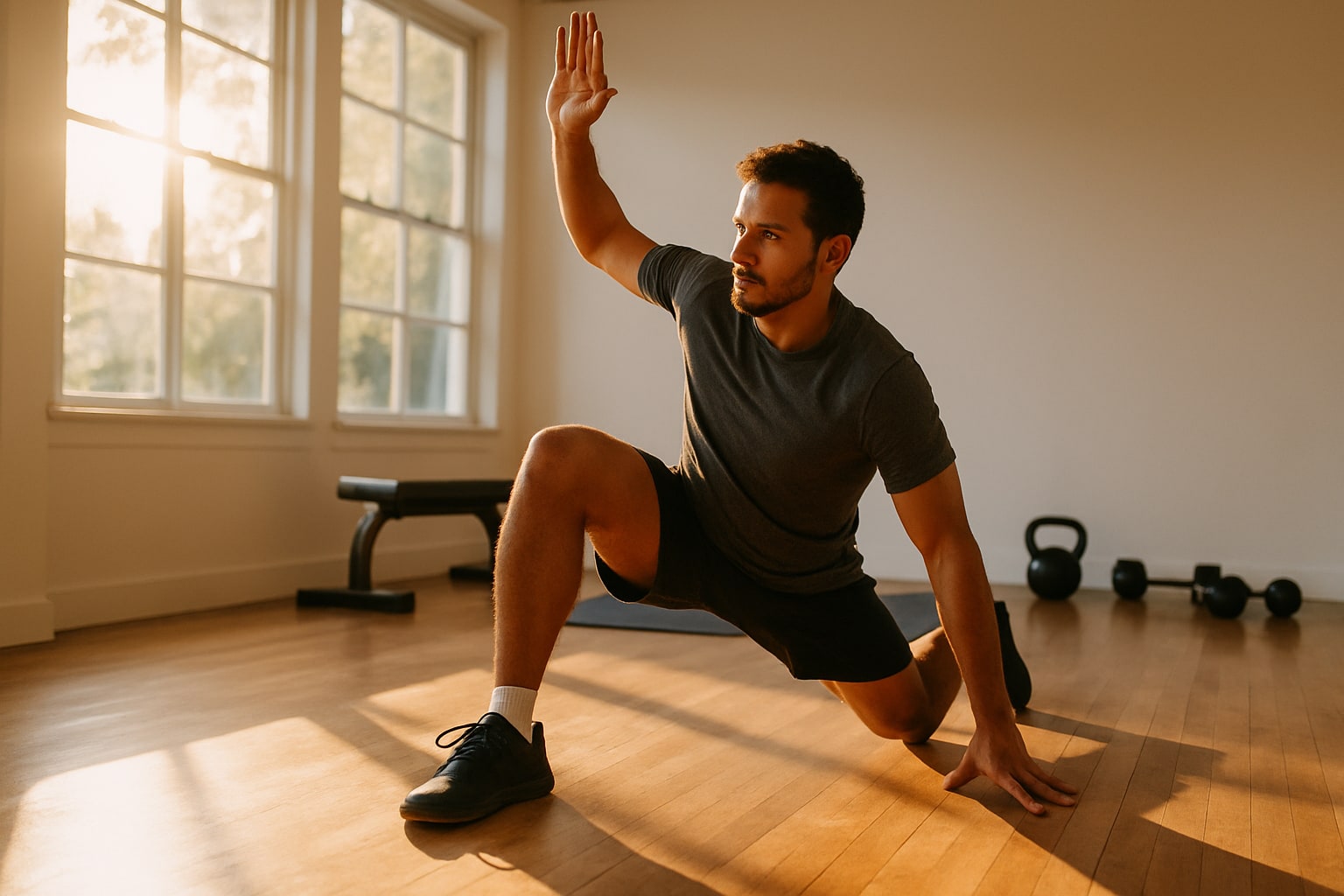
For years you’ve heard that you should stretch before running. And also that stretching beforehand “cools down” the muscle and reduces your performance. Both things can’t be true at once, and in fact they aren’t: the nuance lies in what type of stretching you do and when.
This guide is for you if you train 2-5 days a week (you run, go to the gym, or combine both) and want to stop stretching out of habit. It applies whether you’re a beginner or have been training for years, because the most common mistake is made at every level: using the wrong stretch at the wrong moment.
What each type of stretching is
Dynamic stretching: you move the joint through its full range in a controlled, repeated way. You don’t hold the position. Examples: leg swings, walking lunges, arm circles, trunk rotations.
Static stretching: you take the muscle into a position of tension and hold it for 15 to 60 seconds. Examples: touching your toes while seated, quad stretch holding the ankle, calf against the wall.
There is a third category, ballistic stretching (sharp bouncing), which is now considered inadvisable for most people due to its injury risk. Forget about it unless in very specific sporting contexts.
What the evidence says
This is where the myth falls apart. Several reviews, including Behm et al. (2016) in Applied Physiology, Nutrition, and Metabolism, show that prolonged static stretching (>60 seconds per muscle group) before an effort can reduce strength and power acutely, by between 3% and 5%. The effect is small but measurable, and it disappears within a few hours.
With short durations (<60 seconds) the negative effect is negligible. That is: stretching your quads for 20 seconds before running won’t ruin your session. But it doesn’t offer anything useful for performance either.
In contrast, dynamic warm-up does improve subsequent performance in power, sprinting and jumping. It also reduces the feeling of initial stiffness. That’s why the consensus today is clear: dynamic before, static after (or in separate sessions).
You can go deeper on this point in our guide on stretching before or after training and what the evidence says.
When to do dynamic stretching
Before training, always. They form part of the warm-up; they don’t replace it.
A reasonable routine: 5-10 minutes, 6-8 exercises, 10-15 repetitions per side. Low RPE (3-4 out of 10). You’re not aiming to fatigue, you’re aiming to raise muscle temperature, lubricate joints and prepare the movement pattern you’re going to use.
Examples by context:
- Before running: front and lateral leg swings, walking lunges with trunk rotation, heel to glute, gentle skipping, carioca.
- Before strength training (lower body): unweighted squats, lunges, hip hinge, ankle mobility.
- Before strength training (upper body): arm circles, shoulder rotations with a band, scapular opening, thoracic mobility.
If you run, the specific preparatory work (“drills” or running technique) falls into this category and is highly recommended. It complements the warm-up before training well.
When to do static stretching
Three moments make sense:
1. After training, at relatively low temperature. Not immediately after finishing a hard set, but after 5-10 minutes of cool-down. They help with the feeling of relaxation and can improve joint range over the medium term. The evidence on reducing muscle soreness is limited: don’t expect miracles there.
2. In specific flexibility sessions. If your goal is to gain range (for example, touching the floor with your hands, improving deep squatting), the right approach is 2-3 weekly sessions of 10-20 minutes, with 3-5 repetitions per muscle, 20-45 seconds each. It’s what shows the best cost-benefit in reviews such as Thomas et al. (2018).
3. Away from intense training. In the evening, on a rest day, as an anti-stress routine. Here static stretching works well as a tool for subjective recovery.
Stretching after running: a 6-minute routine
For runners, after the cool-down:
- Calf against the wall: 30 s per leg.
- Soleus (same position, knee bent): 30 s per leg.
- Hamstrings seated or standing: 30 s per leg.
- Quadriceps standing holding the ankle: 30 s per leg.
- Psoas in a lunge with the knee resting on the floor: 30 s per leg.
- Piriformis / glute (figure-4 lying down): 30 s per leg.
If you’re coming off a long run or notice recurring discomfort, also check out iliotibial band syndrome, which is closely linked to glute imbalances.
Flexibility and mobility: they are not the same
Flexibility = the muscle’s passive ability to lengthen. You train it with static stretches. Mobility = the active ability to move a joint with control through its full range. You train it with dynamic exercises, with strength in wide ranges and with specific work (for example, deep squats, Romanian deadlifts, overhead pressing).
For most adults who train, mobility matters more than pure flexibility. Being able to do a deep squat with control is worth more than touching the floor with your hands without bending your knees.
Tools that help (and those that don’t)
Stretching doesn’t need equipment, but some accessories make the routine at home easier:
- Foam roller: brands such as TriggerPoint GRID (around €40-50), Blackroll Standard (€30-40) or the cheaper Decathlon Domyos 500 (€15-20). Useful as a complement before or after, although its effect on performance is modest and its action is more neuromuscular than “breaking up adhesions”.
- Resistance bands: to assist hamstring stretches or open the hip.
- Mat: any model 6-8 mm thick works well.
What you don’t need: expensive massage guns if your only goal is stretching. They’re useful for occasional self-massage, not as a substitute for stretching.
Common mistakes
- Doing long static holds as a warm-up. If you do more than 60 s per muscle before a strength or speed session, you’re losing performance without gaining anything.
- Skipping the dynamic warm-up “because I’m going to jog gently anyway”. Easy jogging warms you up, but it doesn’t prepare the wide hip and ankle ranges you’re going to use.
- Stretching in absolute cold. Right after getting up or arriving from work, without any prior activation. Low risk, but uncomfortable and ineffective.
- Seeking pain. Stretching should feel “a little” uncomfortable (5-6 out of 10 at most). If you’re gritting your teeth, you’re overdoing it.
- Stretching an acute injury. An inflamed tendon or a recent muscle tear doesn’t benefit from passive stretching. See a physiotherapist first.
Warnings: if you are pregnant, avoid very aggressive stretching because of relaxin (greater ligament laxity). If you have a diagnosed hypermobility, prioritise strength over flexibility. For any persistent pain, consult a healthcare professional.
Practical wrap-up: what to do tomorrow
- Before your next training session: spend 6-8 minutes on a dynamic warm-up specific to the movement you’re going to do. No touching your toes for 40 seconds.
- After the session: 5-6 minutes of static stretches, 20-30 seconds per group, prioritising what you’ve worked.
- One day a week: set aside 15 minutes for a session dedicated solely to flexibility and mobility. In 6-8 weeks you’ll notice the change.
FAQ
Is it bad to stretch before running?
It isn’t bad, but if you do long static holds (>60 s per muscle) you may lose some performance in the first few minutes. Switch to dynamic and you’ll gain in how you feel without losing anything.
How long should I hold a static stretch?
Between 20 and 45 seconds per repetition, 2-3 repetitions per muscle. Less than 15 seconds adds little; more than 60 doesn’t add proportional benefit.
Does stretching prevent injuries?
The evidence is limited and depends on context. Dynamic warm-up does seem to reduce muscle injuries in explosive sports; isolated static stretching, not clearly so. What does prevent injuries is strength work.
Can I do only dynamic stretches and skip the static ones?
Yes, if you have no flexibility goals and your mobility is functional. If you notice stiffness or want to gain range, add static stretches 2-3 days a week.
Does stretching get rid of DOMS?
Little or nothing, according to current evidence. It may relieve the subjective feeling of stiffness, but it doesn’t actually speed up muscle recovery. Gentle movement and sleep work better for that.§h232§