Plantar fasciitis: exercises with evidence to resolve it
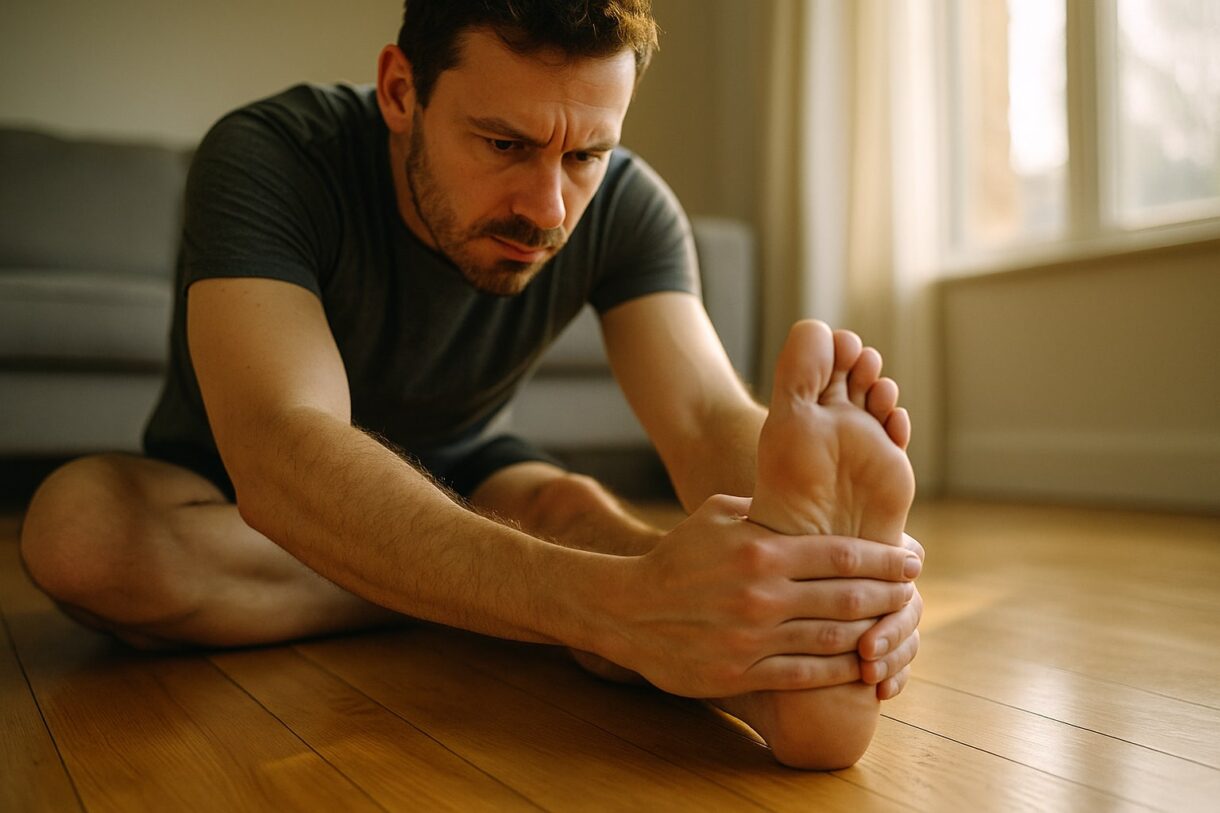
You get out of bed, step on the floor, and that first step hurts as if a shard of glass were stuck in your heel. After walking for a while it improves, but it comes back after sitting for a while or at the end of the day. If this sounds familiar, you probably have plantar fasciitis (more correctly, plantar fasciopathy).
This article is aimed at adults with heel pain lasting more than two weeks who want to know which exercises really work. It is not for elite athletes, and it does not replace a physiotherapist if the condition is severe. It is the information you need to start working at home today.
What plantar fasciitis is and why it hurts
The plantar fascia is a thick band of connective tissue that runs from the heel to the toes. When it becomes overloaded, microtears appear at its attachment to the calcaneus. The typical pain is on the inner part of the heel, worse in the morning or after periods of inactivity.
It affects 10% of the population at some point in their life, according to data published in the Journal of Orthopaedic & Sports Physical Therapy. The clearest risk factors: overweight, a sudden increase in load (more kilometres running, more hours on your feet), inadequate footwear, and limited ankle dorsiflexion.
What the evidence says about treatment
The most cited review is that of Rathleff et al. (2015), published in the Scandinavian Journal of Medicine & Science in Sports. It compared classic stretching with high-load strengthening exercise, and the latter clearly won at 3 months in reducing pain and improving function.
The practical conclusion: stretching helps, but strengthening the fascia and the foot musculature is what moves the needle the most. Subsequent systematic reviews (Cochrane, 2021) agree that exercise combined with education and load management is the first line of treatment.
The Rathleff protocol step by step
This is the exercise with the most support. You need a rolled-up towel and a step.
Execution:
- Place the rolled-up towel under the toes of the affected foot.
- Step onto the step with that foot, letting the heel hang off the edge.
- Raise the heel slowly (3 seconds up).
- Hold for 2 seconds at the top.
- Lower the heel below the step in 3 seconds.
Dose according to Rathleff:
- Weeks 1-2: 3 sets of 12 repetitions, on alternate days.
- Weeks 3-4: 4 sets of 10 repetitions, with a loaded backpack (5-10 kg).
- Week 5 onwards: 5 sets of 8 repetitions, progressively increasing the weight.
It must be done slowly. The tempo (3-2-3 seconds) is not a whim: sustained tension is what stimulates tissue remodelling.
Stretches that are worth it
They do not replace strengthening, but they complement it. Two that have evidence behind them:
Specific plantar fascia stretch (DiGiovanni): seated, cross the affected leg over the other, grab the toes and pull towards the ankle until you feel tension in the sole. 10 repetitions of 10 seconds, 3 times a day. It is the most specific and the one that showed the best results in the DiGiovanni trial (2006).
Calf and soleus stretch against a wall: hands resting on the wall, back leg stretched (gastrocnemius) or bent (soleus). 30 seconds per side, 3 times. Working on dorsiflexion reduces tension in the fascia.
Strengthening the foot and the posterior chain
In addition to Rathleff, add work on the intrinsic foot muscles and the posterior chain:
- Short foot exercise: seated, try to “shorten” the foot by drawing the base of the toes towards the heel without curling them. 3 sets of 10, twice a day.
- Bilateral heel raises: 3 sets of 15, progressing to single-leg.
- Gluteus medius work: weak glutes alter your gait. Bridges and lateral abductions, 3×12.
If you are interested in going deeper into lower-limb work, you have a specific guide on how to strengthen the knees with evidence-based exercises that complements this approach well.
What to do about acute pain
In the first 1-2 weeks, if the pain is high (more than 6/10):
- Roll a tennis ball or a cold bottle under the sole for 5 minutes, 2-3 times a day. Symptomatic relief, not a cure.
- Neuromuscular taping or arch taping: reduces pain in the short term (moderate evidence).
- Reduce load, do not eliminate it. Fewer kilometres, more cycling or swimming.
Common mistakes that delay recovery
- Only stretching and not strengthening. This is mistake number one. Stretching relieves, but it does not remodel the tissue.
- Giving up at 2-3 weeks. The Rathleff protocol needs at least 3 months to produce consistent effects. Clear improvement usually arrives between weeks 6 and 12.
- Progressing the load too quickly. If you add weight before mastering the unloaded phase, the pain rebounds.
- Running through pain above 3/10. Simple rules: if the pain stays below 3/10 during and does not increase the next day, you continue. Above that, you stop.
- Buying insoles without an assessment. Off-the-shelf insoles may help (limited evidence, small effect), but they do not replace exercise.
When to see a doctor or physiotherapist: pain that wakes you at night, visible swelling, tingling or loss of sensation, pain after a direct trauma, or if after 3 months of well-done work you are not improving. In pregnancy, diabetes, or circulatory problems, consult before starting.
What to do tomorrow morning
- Start the Rathleff protocol today: 3×12 with a towel under the toes, on a step, 3-2-3 tempo. Alternate days.
- Add the DiGiovanni stretch 3 times a day: on waking (before stepping down), at midday, and at night.
- Review your weekly load: if you are a runner, reduce volume by 30-40% for the next 2 weeks. If you spend many hours on your feet, consider footwear with some cushioning and a moderate drop (8-10 mm).
If you are a runner, it is worth taking a look at the most frequent running injuries and how to prevent them so you do not fall into the same hole six months from now.
Frequently asked questions
How long does plantar fasciitis take to heal?
With well-done treatment, most people improve significantly between 6 weeks and 3 months. 80-90% resolve in under a year. Chronic cases (more than 12 months) require specialist assessment and, sometimes, therapies such as shockwave therapy.
Can I keep running with plantar fasciitis?
It depends on the level of pain. If it is below 3/10 during the run and does not worsen in the following 24 hours, you can continue with reduced volume. If it hurts more or the first morning step gets worse, stop and prioritise strengthening.
Do insoles help with plantar fasciitis?
The evidence is modest. Off-the-shelf insoles with arch support may provide short-term relief, but they do not speed up healing on their own. Use them as support while you do the active work, not as a substitute.
Does a corticosteroid injection work?
It relieves pain in the short term (4-6 weeks), but several studies show a higher risk of fascia rupture and atrophy of the heel’s fat pad. It is reserved for cases that do not respond to conservative treatment after several months.
Is rolling with a golf ball or a tennis ball better?
A tennis ball or a frozen bottle is more reasonable to start with: distributed pressure and some cold. A golf ball can be too aggressive in the acute phase. None cures on its own; they only relieve symptoms.
Running Healthy Living #ejercicios de recuperación #fascitis plantar #fisioterapia #lesiones deportivas #protocolo Rathleff


 Everything you need to know about muscle memory
 Entrenamiento HIIT: 5 ejercicios para hacer en casa
 Combinar entrenamiento en casa y al aire libre
Comentarios cerrados