RPE: how to measure intensity without a heart rate monitor or power meter
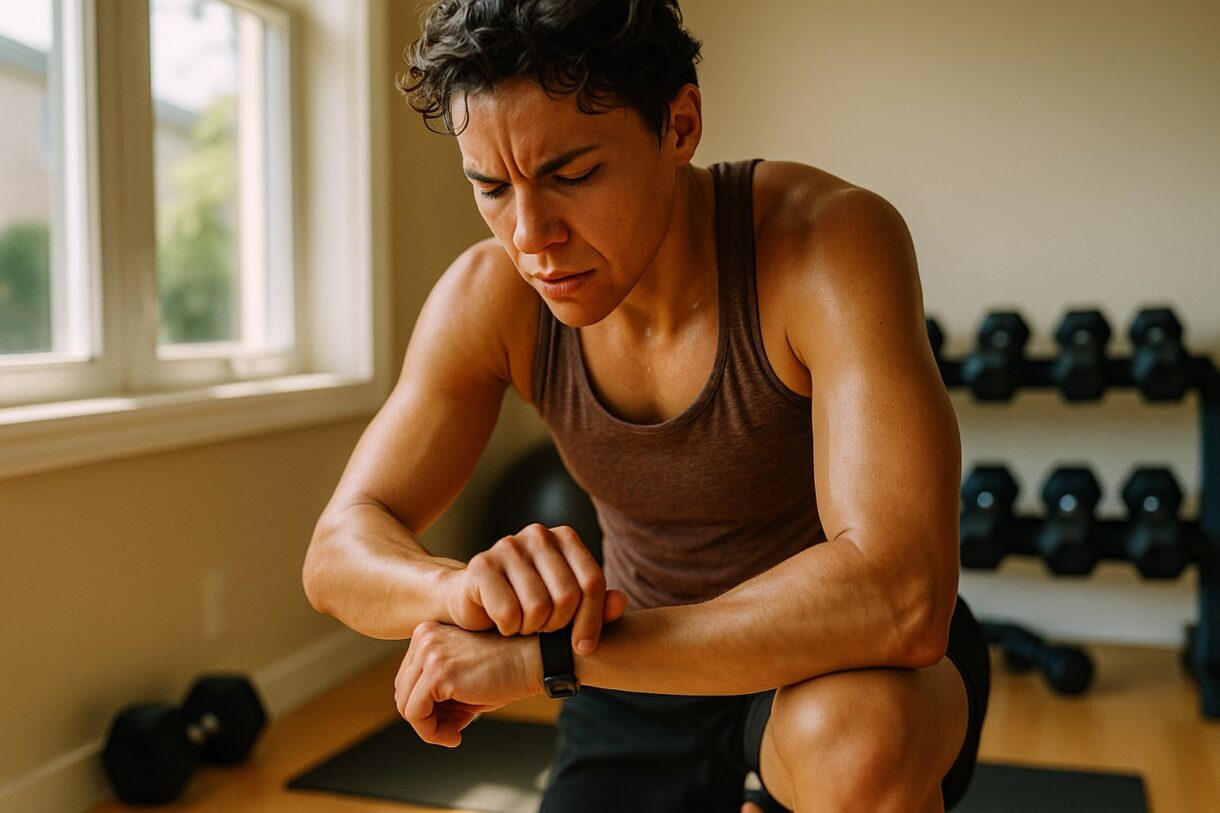
You’ve left your heart rate monitor at home, you head out for a run and think: "great, today I’m going in blind". Not exactly. You’ve been using the best sensor available for decades: your own body. The RPE (Rating of Perceived Exertion) is a validated way to quantify how hard an effort feels, with no cables and no watts.
This article is for you if you train strength, run or cycle regularly (beginner to advanced) and want a reliable tool to regulate intensity when the heart rate monitor fails, the power meter is beyond your budget, or you simply want to train more in tune with how you feel.
What RPE is and where it comes from
RPE is a subjective scale of perceived exertion. It was created by the Swedish physiologist Gunnar Borg in the 1960s, originally with a range of 6 to 20 (the classic Borg scale, designed to correlate with heart rate by multiplying by 10).
Today the Borg CR10 scale, from 1 to 10, is much more widely used. It is more intuitive and has been adopted in strength and endurance training. Numerous studies (Foster et al., J Strength Cond Res, 2001; Scherr et al., Eur J Appl Physiol, 2013) show an acceptable correlation between RPE and objective markers such as lactate or HR during submaximal efforts.
It is not perfect, but it works. And when you calibrate it through practice, it works very well.
The 1-to-10 RPE scale explained
| RPE | Sensation | You can talk | Example |
|---|---|---|---|
| 1-2 | Very light | Singing with no trouble | Walking, warm-up |
| 3-4 | Light | Long sentences | Recovery jog, zone 2 |
| 5-6 | Moderate | Short sentences | Comfortable aerobic run |
| 7 | Hard | Single words | Sustainable medium-high pace |
| 8 | Very hard | Monosyllables | Threshold, tempo run |
| 9 | Near maximal | You can barely talk | VO2max intervals |
| 10 | Maximal | Impossible to talk | Sprint, all-out effort |
In strength training, RPE is interpreted differently: it measures how many repetitions you have left in the tank (RIR, reps in reserve). An RPE 8 = you have 2 reps left. An RPE 10 = muscular failure. It is the variant popularized by Mike Tuchscherer.
RPE in strength training (with RIR)
In the gym, RPE helps you self-regulate the day’s loads. You’re not always fresh. If you program "4×5 at 80%" and you slept 5 hours that morning, that 80% will feel like an RPE 10.
Practical equivalences:
- RPE 6 → you have 4 reps left. Technical work or light volume.
- RPE 7 → you have 3 reps left. Hypertrophy base.
- RPE 8 → you have 2 reps left. Typical zone for effective work.
- RPE 9 → you have 1 rep left. Heavy strength sets.
- RPE 10 → failure. Occasional use (see when to go to failure).
Recommendation by level:
- Beginner: stay at RPE 6-7. You’re not yet calibrated well.
- Intermediate: most of the work at RPE 7-8.
- Advanced: you can touch RPE 9-9.5 on basic exercises, in short blocks.
RPE in running and cycling
Here the 1-10 scale applies as is. It is useful for regulating efforts when you’re not wearing a watch, when your HR is spiking due to heat or stress, or when you want to learn to run by feel.
Approximate equivalence with training zones:
- Zone 1-2 (aerobic base): RPE 3-4. You should be able to talk without breaking up.
- Zone 3 (medium aerobic): RPE 5-6.
- Zone 4 (threshold): RPE 7-8. Half-marathon pace for trained runners.
- Zone 5 (VO2max): RPE 9. 3-5 minute repeats.
- Neuromuscular: RPE 10. Short sprints.
In cycling, RPE is especially useful on long rides when power output is distorted by accumulated fatigue. An RPE 6 at kilometre 20 is not the same wattage as at kilometre 120, and that is exactly what makes the scale useful.
When RPE is preferable to HR or power
- Hot days or dehydration: HR rises 10-20 beats without any increase in real effort (cardiac drift).
- Stress, little sleep or coffee: resting and exercise HR are altered. Here RPE is more honest than your resting HR.
- Short, intense sessions: HR lags behind. A 20-second sprint is over before your pulse reflects the effort.
- Gym strength work: there is no simple objective metric. RIR/RPE is the current standard.
- No device: flat heart rate monitor battery, forgotten watch, power meter beyond budget.
When you should NOT rely on RPE alone: performance tests, week-to-week comparison at low intensity (where HR is more precise), and absolute beginners who cannot yet distinguish "hard" from "very hard".
Common mistakes when using RPE
- Confusing "tired" with "intense". Finishing a set of 20 reps at RPE 7 can leave you wrecked through accumulated fatigue, not real intensity. These are different things.
- Systematic underestimation. Very typical in strength work: you think you have 3 reps left and in reality the bar stalls on the next one. Record yourself and check.
- Overestimation in cardio. Beginners tend to rate efforts at RPE 8-9 when they are really 6. With months of practice you calibrate.
- Mixing the 6-20 and 1-10 scales. Pick one and stick with it. CR10 is more practical.
- Ignoring the context of the day. RPE is relative to your current state, not absolute. That is its value.
Warning: if you have cardiovascular disease, are pregnant, or are returning from injury, do not use RPE as your only reference. Consult your doctor or physiotherapist and complement it with HR or specific guidelines.
Practical wrap-up: what to do tomorrow
- Note your RPE at the end of each set or interval in your next session. Just that. In 2-3 weeks you will start to see patterns.
- Do a "blind" session: go running or cycling without looking at your watch, rate your RPE every 10 minutes and compare with the data when you get home.
- In the gym, program your next block with a target RPE instead of a fixed percentage. Example: 4 squat sets, with the last one at RPE 8.
FAQ
Is RPE useful if I’m a beginner?
Yes, but with a margin of error. For the first 2-3 months your perception is not calibrated. Combine it with HR or an external guideline and adjust as you go.
What is the difference between RPE and RIR?
RIR (reps in reserve) is how many repetitions you have left before failure. In strength training RPE is calculated as 10 minus the RIR. An RIR 2 = RPE 8. They are two sides of the same coin.
Can I train by RPE alone without a heart rate monitor?
Yes, many coaches do, and there is evidence it works well with experienced athletes. For beginners it is best to combine methods for at least a few months.
Does RPE correlate with heart rate?
In moderate, steady efforts, quite well (r≈0.74 according to the meta-analysis by Chen et al., 2002). In very short or very variable efforts, the correlation drops.
Is it useful for HIIT?
Yes, very much so. In short intervals HR lags, so rating each block at RPE 8-9 is usually more useful than chasing a specific pulse.
High Heart Rate Fitness Running #Ciclismo #entrenamiento intensidad #escala esfuerzo percibido #fuerza #RPE #running


 Everything you need to know about muscle memory
 Entrenamiento HIIT: 5 ejercicios para hacer en casa
 Combinar entrenamiento en casa y al aire libre
Comentarios cerrados