How to Strengthen Your Knees: 6 Evidence-Based Exercises for Any Level
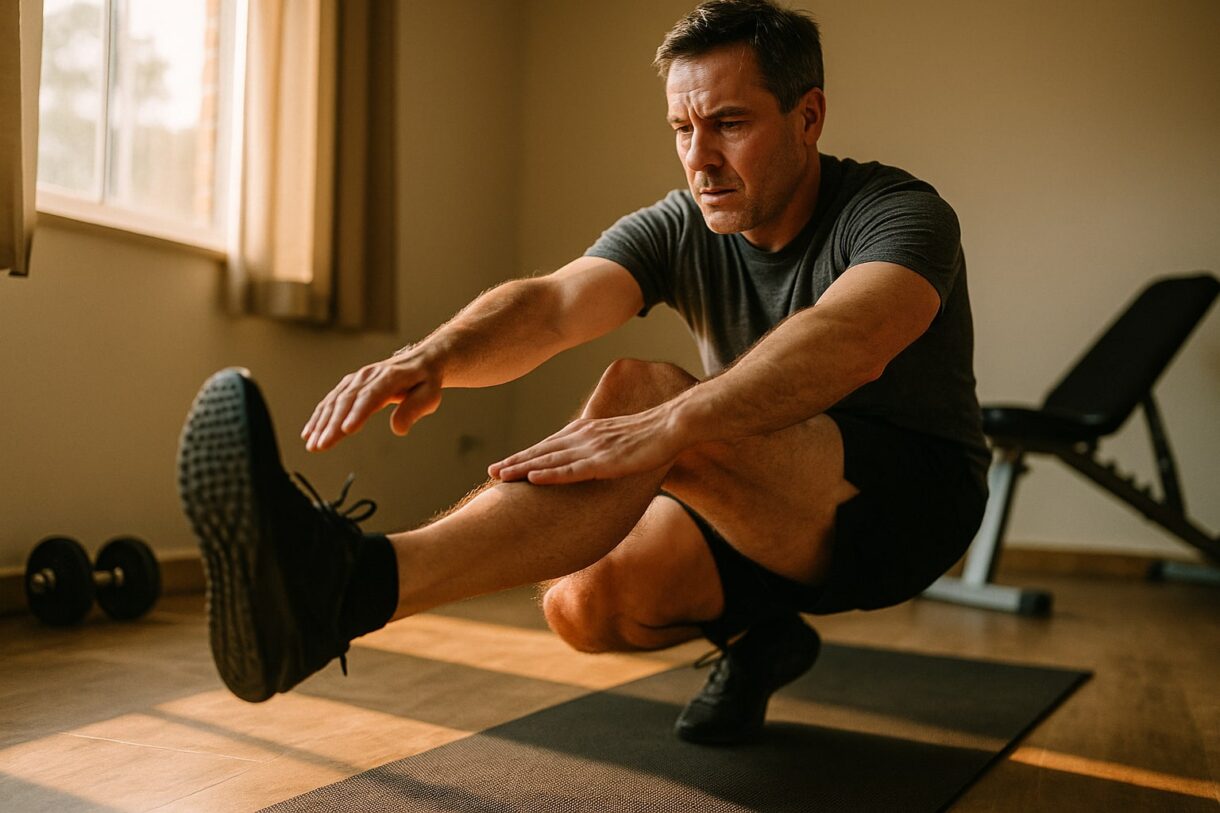
Your knees crack when you go down the stairs. They ache after you’ve run for 20 minutes. Or you simply notice that your squats don’t feel smooth. The knee is a joint that complains early when the muscles around it are underused, and the good news is that it responds very well to properly planned strength training.
This guide is for you if you are a beginner who wants to prevent problems, intermediate who already trains but neglects the legs, or advanced athlete returning from a minor injury. If you have acute pain, visible swelling or a diagnosed injury (meniscus, cruciate ligament, advanced chondromalacia), consult your physio or traumatologist first.
Why knees weaken
The knee doesn’t work alone. It depends on the quadriceps, the hamstrings, the glutes and the stability of the ankle and hip. When any of these pieces gives way, the kneecap and menisci absorb loads that aren’t theirs to bear.
A lack of activity, excess weight and imbalances between muscle groups (strong quadriceps with sleepy glutes, for example) are the usual suspects. A systematic review published in British Journal of Sports Medicine (Lack et al., 2015) confirms that hip and quadriceps strength training significantly reduces patellofemoral pain within 6-12 weeks.
What you’ll take away from this article
Six evidence-based exercises, grouped by function: strength, control and stability. For each one you get a progression by level, a home and gym alternative, and clear criteria for when to increase the load. At the end, common mistakes and a starter routine you can begin tomorrow.
Basic principles before you start
- Frequency: 2-3 sessions per week, with at least 48 h between them.
- Target RPE: 6-8 out of 10 (you should have 2-4 reps left in the tank).
- Range of motion: full whenever it doesn’t hurt. Pain ≠ effort discomfort.
- Progression: increase load or reps once you complete the top of the range with good technique two sessions in a row.
Warming up for 5-10 minutes beforehand is non-negotiable. If you want to go deeper, check out why a proper warm-up reduces injury risk.
The 6 evidence-based exercises
1. Squat (variations by level)
The king exercise for the quadriceps and glutes. A review in Sports Medicine (Schoenfeld, 2010) confirms that working up to 90-120° of knee flexion is safe for healthy joints and maximises muscle activation.
- Beginner: box or chair squat, 3×10-12.
- Intermediate: free bodyweight squat or light dumbbells (5-10 kg), 3×12-15.
- Advanced: goblet squat (12-20 kg) or back squat with barbell, 4×6-10.
At home, a sturdy chair will do. At the gym, a rack with barbell or dumbbells.
2. Lunges (forward, reverse, lateral)
They work the quadriceps, gluteus medius and stabilisers. Reverse lunges are kinder to the front of the knee than forward lunges.
- Beginner: reverse lunge without weight, 3×8 per leg.
- Intermediate: walking lunge with 6-10 kg dumbbells, 3×10 per leg.
- Advanced: loaded Bulgarian split squat (rear foot elevated), 3-4×8 per leg.
3. Glute bridge and hip thrust
The gluteus maximus is a direct ally of the knee: when it works, the femur doesn’t collapse inward (the famous dynamic valgus).
- Beginner: floor glute bridge, 3×15.
- Intermediate: single-leg glute bridge, 3×10 per side.
- Advanced: barbell hip thrust on a bench, 3-4×8-12 (load from 40 kg upwards).
4. Romanian deadlift
Posterior chain: hamstrings and glutes. A hamstring strength deficit relative to the quadriceps is associated with a higher risk of anterior cruciate ligament injury (Myer et al., 2009, American Journal of Sports Medicine).
- Beginner: with light dumbbells (5-8 kg), 3×12.
- Intermediate: with barbell or kettlebell (20-30 kg), 3×10.
- Advanced: single-leg with dumbbell, 3×8 per leg.
5. Step-up (box step-up)
A single-leg exercise that exposes asymmetries. Very useful for runners and for those returning from discomfort.
- Beginner: low box (20-25 cm), no weight, 3×10 per leg.
- Intermediate: medium box (30-40 cm) with dumbbells, 3×10.
- Advanced: high box (45 cm) with load, 3×8.
6. Bulgarian split squat or wall isometric
To train the quadriceps with low joint load. The wall isometric is the flagship exercise in the early stages of rehabilitation for patellofemoral pain.
- Beginner: wall isometric at 45°, 3×30 seconds.
- Intermediate: 3×45-60 seconds, or unweighted Bulgarian split squat 3×10.
- Advanced: Bulgarian split squat with 10-16 kg dumbbells, 3×8-10.
Common mistakes that make your knee worse
- Loading heavily without technical foundation. Before the barbell, learn the pattern.
- Ignoring the glutes. Without active gluteus medius, the knee caves inward. Work on abductions, monster walks or clamshells as a complement.
- Partial range out of fear. If there is no pathology, lowering fully is safer in the long run than staying halfway.
- Training only the quadriceps. Hamstrings and glutes are just as important. If you’re unsure how much to train each group, review your weekly volume per muscle group.
- Confusing discomfort with pain. Muscle soreness the next day: normal. Sharp joint pain or swelling: stop and consult.
Who should not follow this routine as-is: pregnant women in the third trimester (adapt loads), people with knee replacements, recent ligament injury or symptomatic advanced osteoarthritis. In those cases, an individualised plan with a physio is needed.
What to do tomorrow
- Choose 3 exercises: chair squat, glute bridge and Romanian deadlift with light dumbbells. 3 sets of 10-12 reps.
- Log your RPE and how you felt on your phone. Without tracking there is no real progression.
- Schedule your next session in your calendar. Twice a week for 6 weeks. Then reassess.
Frequently asked questions
How long does it take to strengthen your knees?
With consistent work 2-3 times a week, subjective improvements (less discomfort, more stability) usually appear between weeks 4 and 8. Real structural strength changes take 12 weeks or more.
Can I do these exercises if my knees crack?
Painless cracking (crepitus) is common and does not indicate damage. If there is no pain or swelling, you can train normally. If discomfort appears, reduce range and load.
Does running wear out your knees?
The evidence says no. A meta-analysis in Journal of Orthopaedic & Sports Physical Therapy (Alentorn-Geli et al., 2017) shows that recreational runners have a lower prevalence of knee osteoarthritis than sedentary people. The problem is running with a poor strength base, not running itself.
Are knee sleeves useful for training?
As occasional protection during heavy loads or after an injury, they can help. As a daily crutch, they create dependence and weaken the stabilising muscles. Use them only when they add value, not by default.
Are machines or free weights better for the knees?
Free weights train more stabilisers and transfer better to real life. Machines are useful in early phases or after injury, when you need to isolate the quadriceps without demanding balance. Ideally, combine both.
Fitness Healthy Living #ejercicios de fuerza #fisioterapia deportiva #fortalecimiento rodillas #prevención lesiones


 Everything you need to know about muscle memory
 Entrenamiento HIIT: 5 ejercicios para hacer en casa
 Combinar entrenamiento en casa y al aire libre
Comentarios cerrados