Rest between sets: how long to wait based on your goal
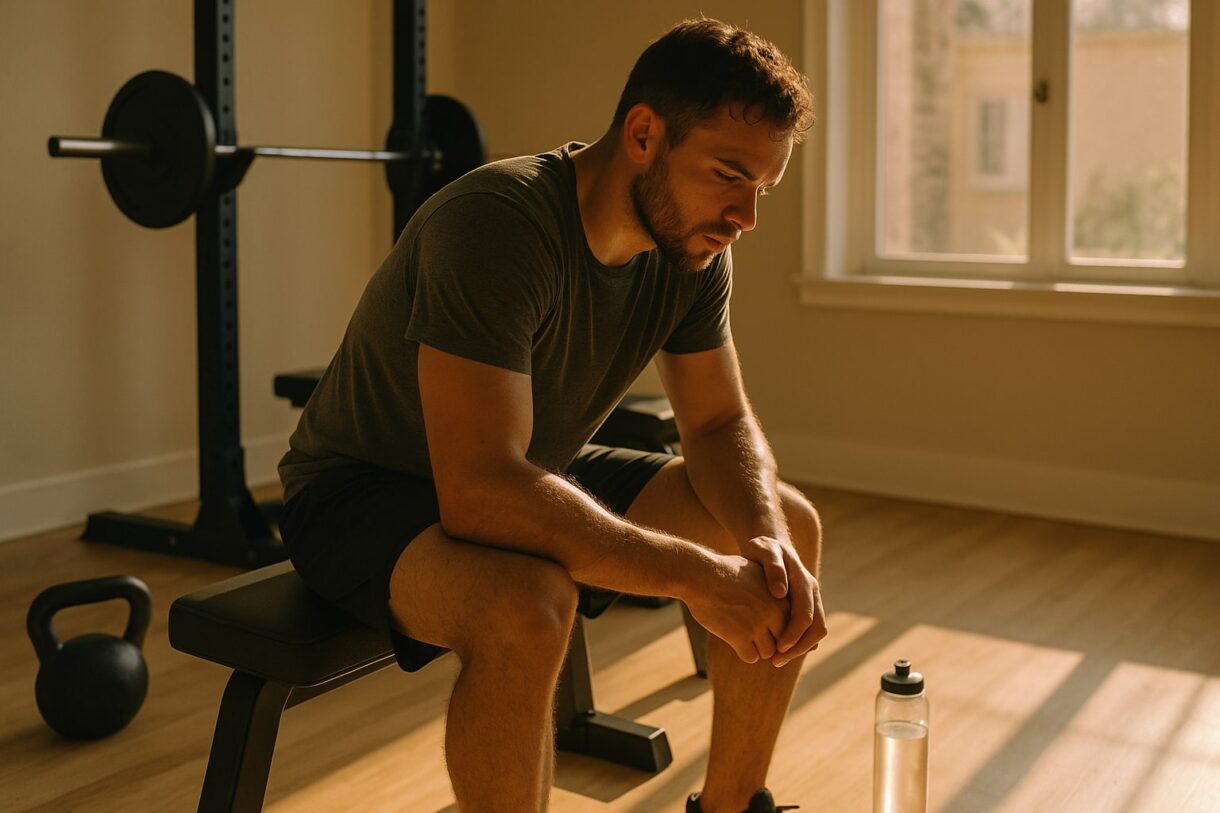
You’re in the gym, you finish a set of squats and glance at the clock. One minute? Three? Until the breathlessness fades? This question is more common than it seems, and the answer makes a big difference to the result of your training.
This article is for you if you train strength in a gym or at home and want to refine your routine without overcomplicating it. It applies whether you’ve been lifting for six months or several years. Let’s look at the specific ranges and the reasoning behind them.
Why rest between sets matters more than you think
Rest between sets is not dead time. It is an active part of the training stimulus. It determines how much force you can produce in the next set, which energy system you rely on, and what adaptation the training provokes.
Resting too little when you’re aiming for maximal strength means you lift less weight than you could. Resting too long when you’re aiming for hypertrophy dilutes the metabolic stress. Neither is “better” in absolute terms: it depends on your goal.
What happens in your body while you rest
Three processes occur in parallel during the pause:
- ATP and phosphocreatine resynthesis (ATP-PC): the system you use in short, intense efforts recovers to 70% in about 30 seconds and to nearly 100% between 3 and 5 minutes.
- Clearance of lactate and H+ ions: muscular acidity gradually drops. At 60-90 seconds there is still accumulated metabolic stress; at 3 minutes it is largely cleared.
- Neuromuscular recovery: the central nervous system needs more time than people think. After a heavy set of squats or deadlifts, strength does not return to 100% until 3-5 minutes have passed (Grgic et al., 2018, Sports Medicine).
Understanding this lets you choose your rest based on which system you want to stress.
Rest for maximal strength: 3-5 minutes
If you work in the 1-5 repetition range at 85-95% of your 1RM, you need 3-5 minutes between sets. Sometimes even more for lifts like heavy squats or deadlifts.
A meta-analysis by Grgic and colleagues (2018) confirmed that short rests (under 2 minutes) significantly reduce total volume lifted in strength work. Less volume at the same intensity means less neural adaptation.
Practical tip: set a timer. If you rest “by feel”, you almost always fall short.
Rest for hypertrophy: 60-90 seconds… or more
Here is the biggest paradigm shift of the last decade. For years it was said that 60-90 seconds was ideal for hypertrophy because of the post-exercise hormonal response. Current evidence nuances this.
Schoenfeld et al. (2016, Journal of Strength and Conditioning Research) compared 1-minute and 3-minute rests with the same volume. Result: the 3-minute group gained more muscle mass and more strength.
The practical conclusion? For hypertrophy:
- Compound exercises (squat, bench press, row, deadlift): 2-3 minutes.
- Isolation exercises (biceps curl, triceps extension, lateral raises): 60-90 seconds.
If you cut rest too short, you sacrifice effective repetitions. And effective sets are the ones that truly stimulate hypertrophy.
Rest for muscular endurance: 30-60 seconds
If you’re training endurance (circuits, sets of 15-20+ repetitions at 50-65% of 1RM), short rests are part of the stimulus. 30-60 seconds generates lactate accumulation and improves tolerance to prolonged effort.
Here the goal is not to lift more weight but to sustain tension for longer. Typical RPE at the end of the set: 7-8 out of 10.
Rest for power: 2-5 minutes
Explosive work (jumps, cleans, throws, loaded sprints) requires long rests, between 2 and 5 minutes, even though the sets are short. The reason: power depends on full recovery of the ATP-PC system and the nervous system.
If you perform power cleans with 60 seconds of rest, you are not training power. You are training endurance with dangerous technique.
Summary table: how long to rest by goal
| Goal | Reps | % 1RM | Rest | Target RPE |
|---|---|---|---|---|
| Maximal strength | 1-5 | 85-95% | 3-5 min | 8-9 |
| Hypertrophy (compound) | 6-12 | 70-80% | 2-3 min | 7-9 |
| Hypertrophy (isolation) | 8-15 | 65-75% | 60-90 s | 7-9 |
| Muscular endurance | 15-25 | 50-65% | 30-60 s | 7-8 |
| Power | 1-5 | 30-60% (explosive) | 2-5 min | 6-7 |
How to adapt it to your level
Beginner (less than 1 year training): stay in the low end of each range. You are not yet moving loads high enough to need 5 minutes between sets. 90-120 seconds on most exercises will serve you well.
Intermediate (1-3 years): apply the ranges as they are. Differentiate between compound and isolation. Use a timer.
Advanced (3+ years): you probably need more rest than you think, especially for heavy squats and deadlifts. 4-5 minutes is not excessive.
Common mistakes
- Resting while looking at your phone without control. Without a timer, you tend to lengthen rest on comfortable exercises and shorten it on hard ones. Exactly the opposite of what works.
- Applying the same rest to everything. A biceps curl and a squat do not demand the same.
- Copying someone else’s rest. Your training partner weighs 20 kg more or has been training 5 years longer. Their timings are not yours.
- Confusing “not out of breath” with “recovered”. The cardiovascular system recovers before the muscular and neural systems do. You can breathe comfortably and still not be ready for another heavy set.
- Cutting rest short to “finish sooner”. If you’re in a hurry, reduce exercises or sets, not the rest. You will lose less performance.
Warning: if you have uncontrolled hypertension, heart disease, or are returning from an injury, consult your doctor or physiotherapist before applying short rests with heavy loads.
What to do tomorrow in your next session
- Get a timer on your wrist or phone. No “by feel”.
- Split your routine between large exercises (2-3 min) and isolation exercises (60-90 s). Note the rest on your template.
- Try two weeks with the ranges in this article and compare: are you lifting more weight? Do you reach the last repetitions in better shape? Adjust from there.
Frequently asked questions
Can I do supersets to save time?
Yes, especially by combining antagonist muscles (biceps/triceps, chest/back). You maintain density without losing too much performance. Avoid them on heavy compound exercises if you’re pursuing pure strength.
Will resting longer make me lose my “warm-up”?
No. After the initial warm-up, 3-5 minutes between sets will not cool you down. In fact, a good initial warm-up means long rests do not affect performance.
What if I train at home with little equipment?
With light loads and more repetitions, rests of 45-75 seconds usually work well. Since you don’t reach high intensities, you don’t need the 3 minutes of the gym.
Is it OK to walk during rest?
Yes, gentle walking or light movement helps venous return and lowers heart rate. Avoid intense active exercise between sets if you’re pursuing strength or hypertrophy.
How long before I notice a change if I adjust my rest?
Between 3 and 6 weeks to see clear differences in strength or volume lifted. Visible hypertrophy takes longer, around 8-12 weeks, and depends on other factors (diet, sleep, total volume).
High Heart Rate Fitness #descanso entre series #entrenamiento fuerza #fitness #hipertrofia #recuperación muscular


 Everything you need to know about muscle memory
 Entrenamiento HIIT: 5 ejercicios para hacer en casa
 Combinar entrenamiento en casa y al aire libre
Comentarios cerrados