Groin pain in amateur footballers: prevention with core and adductor training
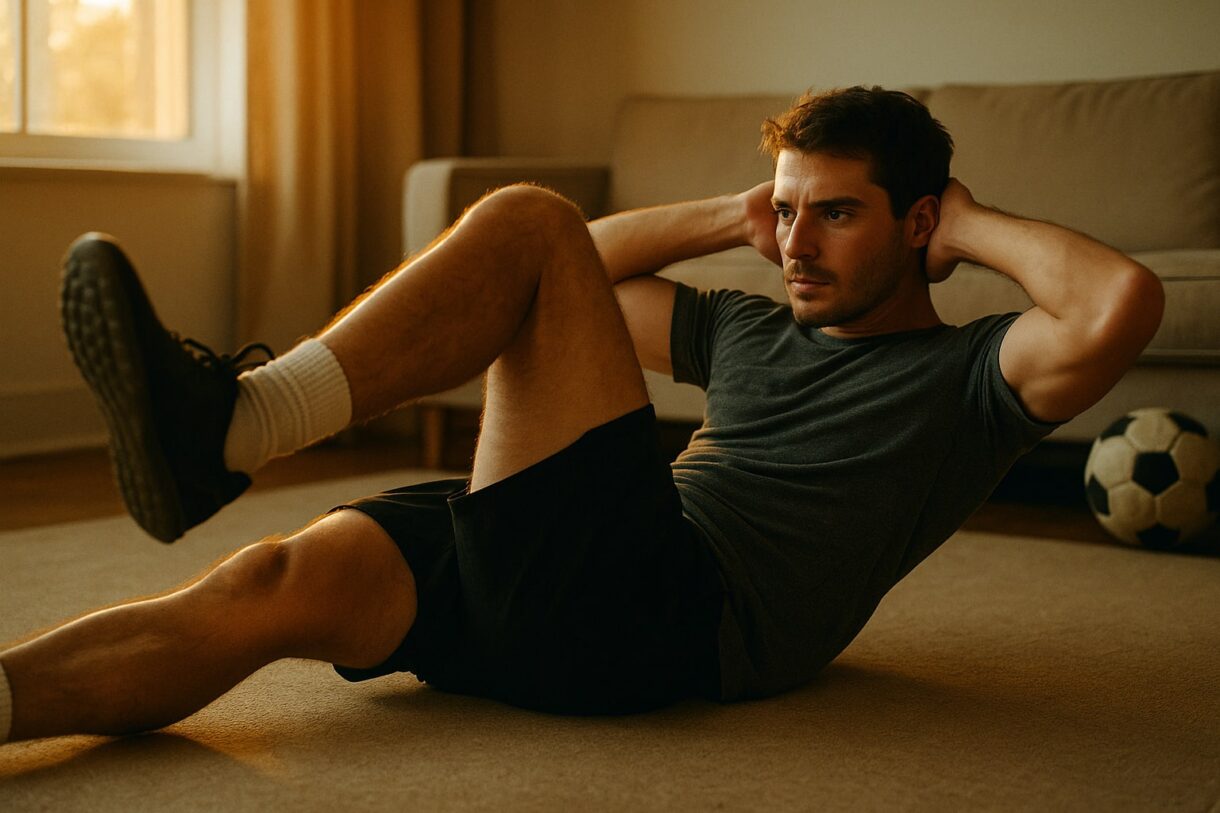
For weeks you’ve been noticing discomfort in your groin after matches. It’s not sharp pain, but it’s there: when you strike the ball, when you change direction, when you get up from the sofa the next day. If you play football two or three times a week and this sensation sounds familiar, this article is for you.
It is aimed at beginner to intermediate amateur footballers who want to prevent groin pain before it becomes a chronic problem. If you already have established pain lasting more than 4-6 weeks, go straight to the section on medical referral.
What groin pain is and why it affects amateur footballers so much
Groin pain (athletic pubalgia) is localised pain in the pubic area, the groin or the lower abdomen. It is not a single injury but a condition that can encompass adductor tendinopathy, pubic osteitis, sports hernia or dysfunction of the deep abdominal musculature.
In amateur football the problem is twofold: a heavy load of technical movements (kicking, turning, braking) and a poor base of specific strength. A study by Werner et al. published in the British Journal of Sports Medicine (2019) places groin injuries at 12-16% of all football injuries, with particularly high incidence in players who do no structured preventive work.
Risk factors: why it could happen to you
The most consistent factors in the literature are:
- Weak adductors: an adductor/abductor strength ratio below 0.80 multiplies the risk.
- Weak or poorly coordinated core, especially the transversus abdominis and obliques.
- Previous history of groin injury (the strongest predictor).
- High match volume without a strength base: typical of the amateur player who trains little and plays a lot.
- Sudden changes in load: crash pre-seasons, weekend tournaments.
Age between 25 and 40 and pelvis-hip imbalances are also frequently cited, although the evidence is more limited.
How to recognise the first symptoms
The typical pattern starts like this: diffuse groin discomfort after the match, which disappears the next day. Later it appears when warming up and then subsides. Further on, it hurts when kicking with the instep, when sprinting or when getting out of bed.
Warning signs:
- Localised pain in the pubis or adductor insertion lasting more than 2 weeks.
- Discomfort when doing a sit-up or coughing.
- Bilateral pain (in both groins).
- A sensation of a “pull” when opening your legs.
If this sounds familiar, stop intense training and read the referral section.
The Copenhagen Adduction Exercise: the exercise with the most evidence
The Copenhagen Adduction Exercise is, at present, the exercise with the best scientific backing for preventing adductor injuries in football. The study by Harøy et al. (British Journal of Sports Medicine, 2019) showed a 41% reduction in the incidence of groin injuries in footballers who incorporated it 1-3 times a week for 8-10 weeks.
How it is done: lying on your side, with the top foot resting on a teammate’s shoulder (or on a bench). You lift your hips and bring the bottom leg up to touch the top one, without letting the pelvis drop.
Suggested progression:
| Week | Sets x reps per side | Frequency |
|---|---|---|
| 1-2 | 1 x 3-5 | 1 day |
| 3-4 | 2 x 6-8 | 2 days |
| 5-8 | 3 x 8-10 | 2-3 days |
Target RPE: 6-7 out of 10. If pain exceeds 3/10, stop.
FIFA 11+ protocol: a warm-up backed by evidence
The FIFA 11+ is a 15-20 minute warm-up programme designed to reduce injuries in amateur football. Silvers-Granelli et al. (American Journal of Sports Medicine, 2015) reported an overall 30-50% reduction in injuries in teams that applied it at least twice a week.
It includes three blocks: technical running, strength and stability (planks, squats, Nordic hamstrings) and agility exercises. It is available free on the FIFA Medical website. It is worth more than any improvised 5-minute warm-up with rondos.
If you still don’t warm up properly, you may be interested in this article on why warming up well reduces the risk of injury.
Core: what to train and what not to
The core you need is not “doing 100 sit-ups”. It is lumbo-pelvic stability. The exercises with the best cost-benefit ratio:
- Front plank: 3 sets of 30-45 seconds.
- Side plank: 3 x 20-30 seconds per side (key for the obliques).
- Dead bug: 3 x 8-10 repetitions per side, with breathing control.
- Bird dog: 3 x 8 per side.
- Pallof press with a band: 3 x 10 per side.
Frequency: 2-3 days a week, 10-15 minutes. Combine it with Copenhagen and you have the foundation.
Common mistakes when preventing groin pain
- Stretching the adductors cold or when they already hurt. Aggressive static stretching on an irritated tendon worsens the condition. Here is a guide on dynamic vs static stretching.
- Going all out with Copenhagen in the first week. It is a very demanding exercise. Start with 3-5 reps and progress gradually.
- Doing only traditional abdominals. The classic crunch does not train the stability you need and can overload the pubis.
- Ignoring pain for 2-3 weeks “to see if it goes away”. Chronic groin pain takes months to resolve.
- Returning to competition without having recovered strength. If after a discomfort you cannot do Copenhagen without pain, you are not ready to play.
Contraindications: if you are pregnant, have a diagnosed inguinal hernia, recent abdominal surgery or hip pathology (impingement, osteoarthritis), consult your doctor or physiotherapist first.
Practical conclusion: what to do this week
- Add 10 minutes of FIFA 11+ to the warm-up of every training session. At least 2 days a week.
- Introduce the Copenhagen Adduction Exercise: start with 1 set of 3-5 repetitions per side, 2 days apart with 48 hours between sessions.
- Replace classic abdominals with side planks and dead bugs over the next 6 weeks.
If groin pain appears and lasts more than 2 weeks, stop and consult a physiotherapist or sports doctor. Groin pain is better treated early than late.
Frequently asked questions
Can I keep playing if I have mild groin discomfort?
If the pain is below 3/10 and disappears when you warm up, you can continue but reducing load and adding preventive work. If it exceeds 3/10, lasts more than 2 weeks or worsens when kicking, stop and consult.
How long does groin pain take to heal?
It depends on the subtype and chronicity. Mild cases detected early: 4-8 weeks. Chronic conditions with pubic osteitis or established tendinopathy: 3-6 months. The evidence is clear that returning too early is the main factor in relapse.
Are bandages or compression belts useful?
As an isolated measure, the evidence is limited. They may give a temporary feeling of stability, but they do not replace strength work. Use them as a complement, not as a solution.
Is groin pain the same as sports hernia?
No. Sports hernia is a weakness in the posterior abdominal wall without a visible hernia. Groin pain is a broader term. Differential diagnosis is made by a sports doctor through examination and imaging.
Can I do Copenhagen if I already have pain?
It depends on the phase. In acute pain, no. In the subacute phase and under physiotherapist supervision, yes: there are rehabilitation protocols that use it as a central exercise, starting with regressed versions (knee resting on the ground instead of the foot).
Football Fitness #aductores #core training #fútbol amateur #prevención lesiones #pubalgia

 Everything you need to know about muscle memory
 Entrenamiento HIIT: 5 ejercicios para hacer en casa
 Combinar entrenamiento en casa y al aire libre
Comentarios cerrados