Treadmill vs. road: real pace and incline equivalences
Treadmill running and road running are not the same: we explain, with data and studies, how to convert your pace from one to the other using the 1% incline rule.
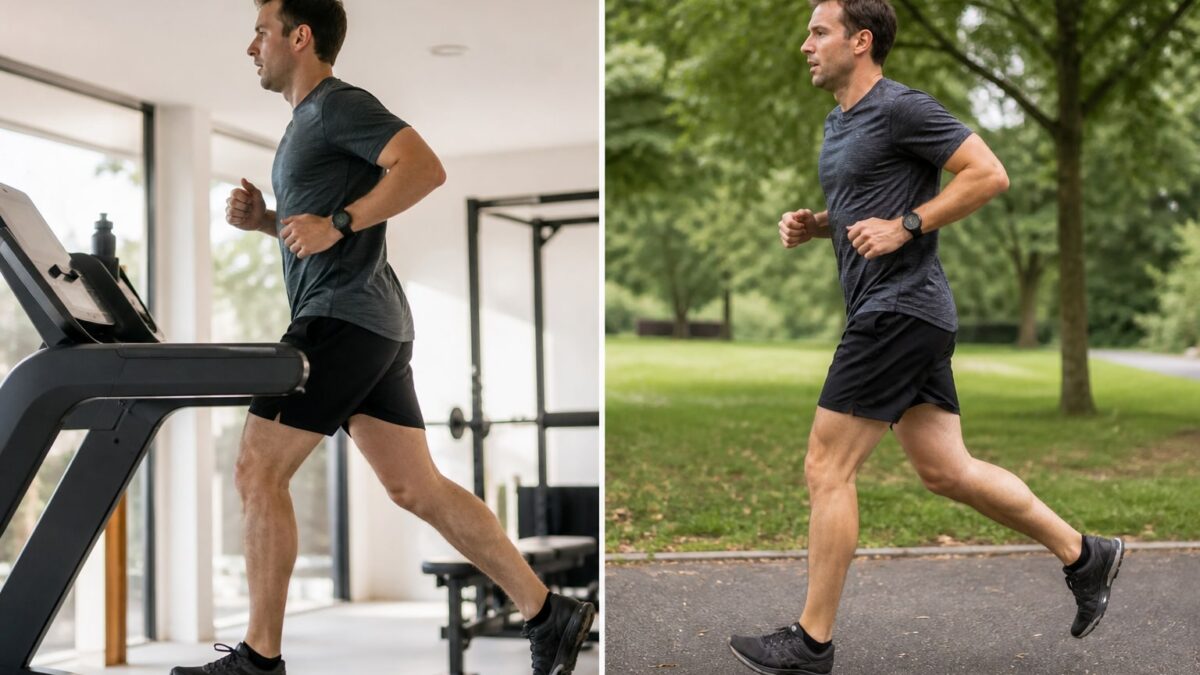
Are you running 5:00 min/km on the treadmill and then, when you head out onto the road, you struggle to hold 5:20? It’s not you. It’s physics and physiology, and there is a fairly precise numerical explanation.
This article is aimed at beginner and intermediate runners who train on a treadmill for convenience, weather or work shifts, and want to know how to transfer that training to a real race. It is also useful if you train on the road and want to make use of the treadmill on rainy days without losing your pace reference.
Why the treadmill feels easier than the road
On the treadmill, the belt pushes you backwards. On the road, you have to overcome your own body weight and, in addition, air resistance. At typical race paces (between 4:00 and 6:00 min/km), that air resistance represents a real energy cost, even though you don’t notice it consciously.
On top of this, there is no headwind inside a gym, no changes in gradient, and no stops at traffic lights. The treadmill surface also tends to be more uniform and gives somewhat more energy return than asphalt. Together, all of this means that the same numerical pace costs less on the treadmill.
The 1% incline rule
The key reference study here is that of Jones AM and Doust JH, published in the Journal of Sports Sciences in 1996. The authors measured the energy cost of running on a treadmill and on the road at several speeds, and found that setting the treadmill to a 1% incline fairly faithfully reproduces the energy expenditure of running outdoors on the flat, at moderate training speeds.
That 1% figure has become the standard recommended by most coaches and exercise physiologists. Below that 1%, the treadmill compensates too little for the absence of air resistance; above it, it overcompensates at slow paces. It is not an exact physical law for every speed, but it is the best approximation available based on the evidence.
Treadmill vs. road pace equivalence table
This table is based on the logic of the Jones and Doust study and on how the effect of relative wind scales with speed. At slow paces, the difference is small; at fast paces, the air weighs more.
| Treadmill pace (1% incline) | Approximate road pace | Approx. difference |
|---|---|---|
| 6:00 min/km | 6:00–6:05 min/km | Minimal |
| 5:30 min/km | 5:30–5:35 min/km | Minimal |
| 5:00 min/km | 5:00–5:10 min/km | Slight |
| 4:30 min/km | 4:25–4:35 min/km | Slight-moderate |
| 4:00 min/km | 3:55–4:05 min/km | Moderate |
| 3:30 min/km | 3:25–3:35 min/km | Moderate-high |
These are indicative ranges, not an exact calculator. They depend on your weight, your technique and how much real wind there is on race day.
How to convert your treadmill pace to road pace
Quick formula
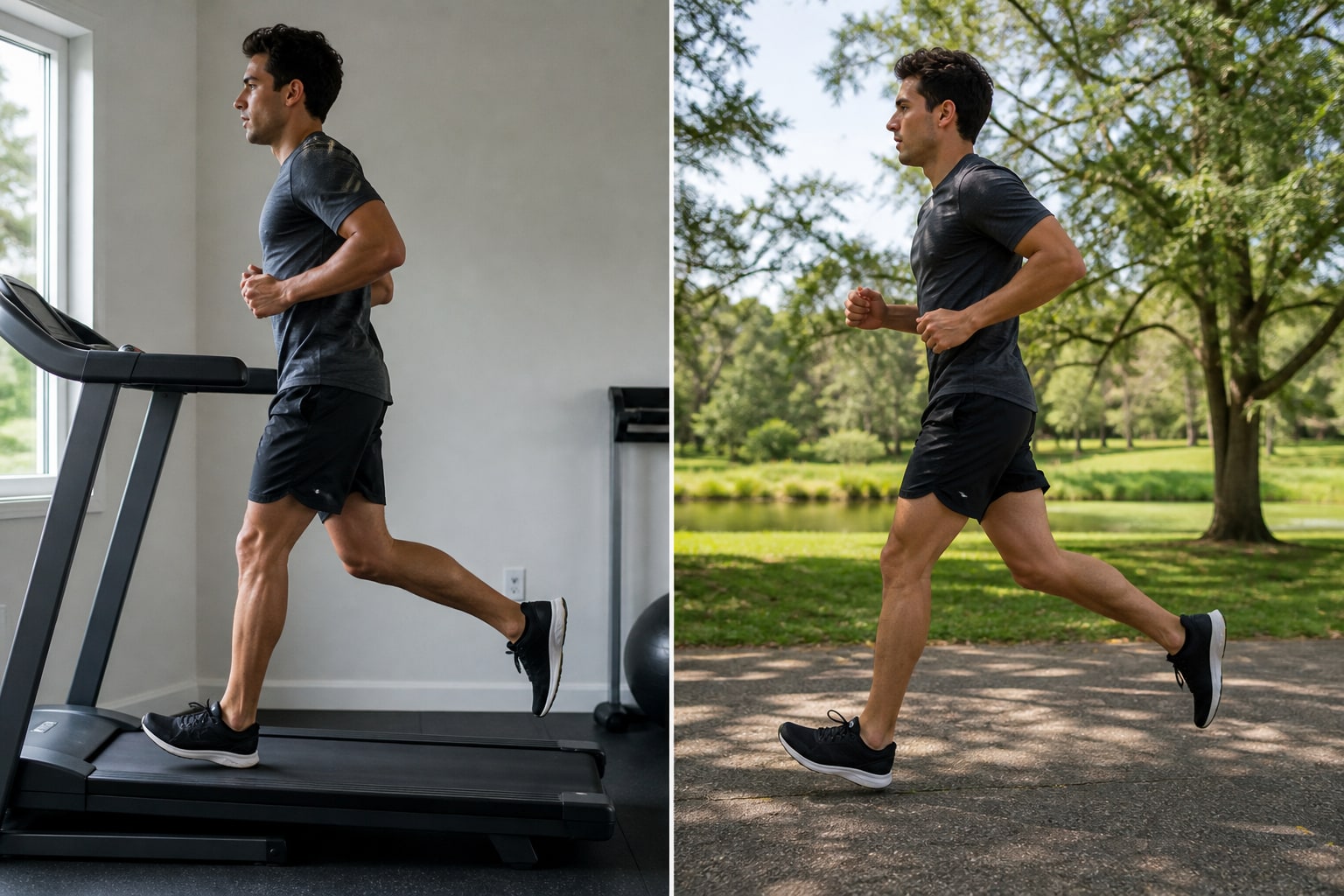
For continuous runs and easy runs, the practical recommendation is simple: set the treadmill to a 1% incline and run at the same pace you would run on the road. There is no need to subtract or add seconds; with that gradient setting you are already matching the effort reasonably well.
If you want to simulate a session of fast intervals (below 4:00 min/km), raise the incline to 1.5–2% to better compensate for air resistance at those speeds, according to the same Jones and Doust study.
Practical example
If on the road your easy run pace is 5:30 min/km, on the treadmill at a 1% incline you also run at 5:30 min/km. If you want to replicate an interval session at 3:45 min/km, raise the treadmill to 2% and keep that same numerical pace. Using heart rate or RPE as a check helps you verify that the effort matches; here is a guide on RPE for measuring intensity without a heart rate monitor or power meter.
Factors that change the equivalence: wind, temperature and surface
Headwind increases energy cost non-linearly: the faster you go, the greater the penalty. With a strong headwind (more than 20 km/h), the real effort on the road can be noticeably higher than the table above suggests, even when running more slowly.
Temperature also has an influence. Above 25 °C, the body devotes more resources to dissipating heat, which raises heart rate at the same pace. The surface matters less than it seems between asphalt and treadmill, but there are clear differences if you compare with trail; you can see the details in trail vs. asphalt: what changes in training, footwear and recovery.
Training on the treadmill to race on the road: what works and what doesn’t
It works well for: controlled intervals, easy runs, technique work and training on bad-weather days. The treadmill gives you a constant, objective pace, something that on the road depends on your feel or a GPS watch.
It does not fully replace: race-pace training with its real curves, hills and uneven surfaces. If your goal is a specific race, it is advisable to do at least part of your intervals and long runs on the real terrain where you will compete. If you’re not yet clear on which distance to prepare for, how to choose your first road race: 5K, 10K or half marathon may help.
Common mistakes when comparing treadmill and road
- Running on the treadmill with no incline (0%) and expecting the pace to be comparable to the road: it will always come out faster than the real one.
- Relying only on pace without looking at heart rate or RPE as a cross-reference.
- Raising the incline too much (above 2–3%) thinking that this makes it “more like the road”: beyond that you are simulating a hill, not a flat.
- Ignoring the wind on race day and being surprised that the treadmill pace isn’t sustained in the same way.
- Comparing isolated sessions instead of averages: a single day of wind or heat can distort your perception of the equivalence.
What to do tomorrow
- Set the treadmill to a 1% incline in your next easy run and note how the effort feels compared with the same pace on the road.
- Compare your heart rate at a fixed pace on the treadmill and on the road over a week; if you use a GPS watch, check which metrics are worth watching in this guide to GPS running watches.
- Set aside at least one long run and one interval session per week on the road if you have an upcoming race, even if you train the rest on the treadmill.
Frequently asked questions
Why does the treadmill feel easier than running on the road?
Because the belt moves you backwards and there is no air resistance or changes in gradient. At typical training paces, that air resistance represents a real energy cost that doesn’t exist on the treadmill unless you adjust the incline.
What incline should I set on the treadmill to make it like running on the road?
1% is the reference supported by the Jones and Doust (1996) study for moderate training paces. For fast intervals, below 4:00 min/km, 1.5–2% is a better match.
How do I convert my treadmill pace to road pace?
For easy runs, the same pace number at a 1% incline is a good approximation. For fast paces, expect a difference of about 5–10 seconds per kilometre, with the road being somewhat more demanding.
Is it enough to train only on the treadmill if I’m going to race on the road?
It works as a base, but it is not sufficient. It is advisable to include at least one long run and one session of race-specific pace per week on the real terrain, especially in the last weeks before the race.
Does wind change the treadmill-road equivalence a lot?
Yes, and non-linearly: the faster you run, the more a headwind penalises you. In a strong wind, your real pace on the road may cost considerably more than any standard equivalence table suggests.

0 comments · Comment