Rotator cuff injury: the injury that ruins your pull-ups and bench press
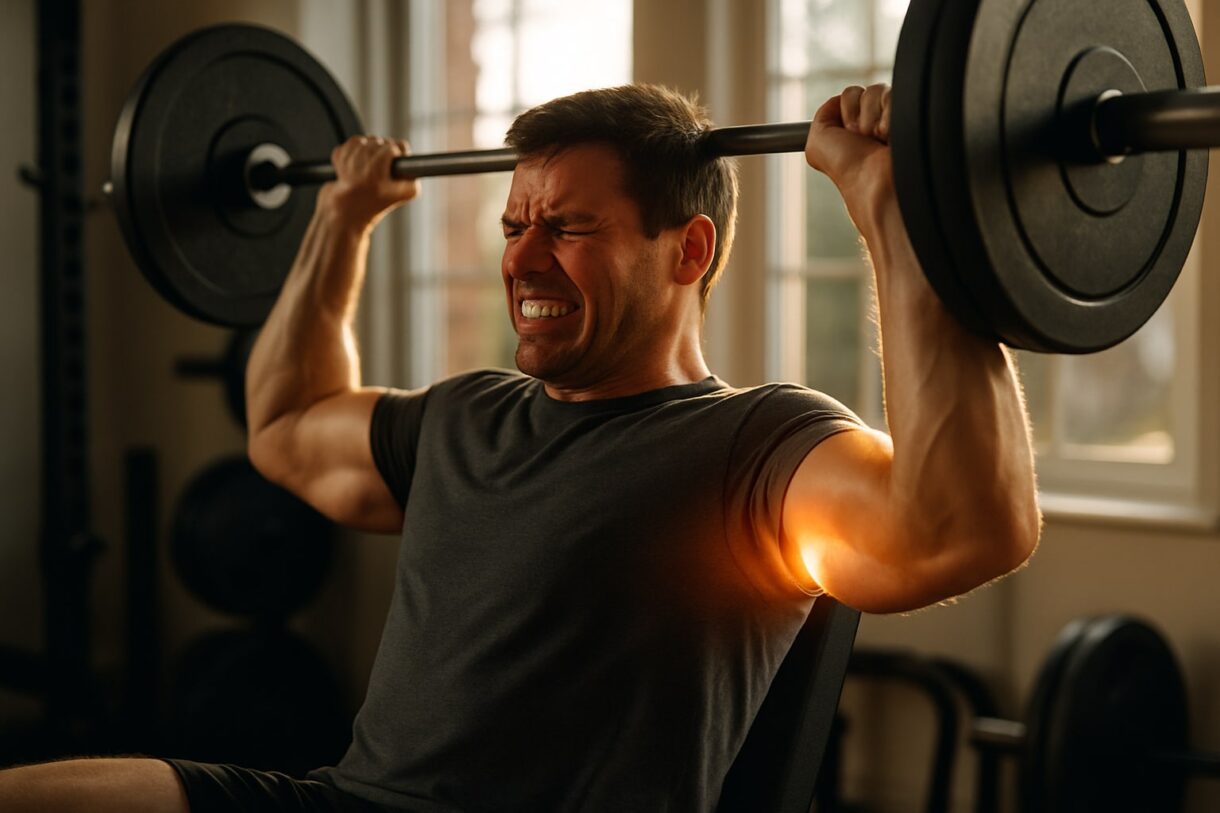
You’ve spent months progressing on bench press and pull-ups. One day you feel a stab in your shoulder when lowering the bar to your chest. The next day it’s hard to comb your hair. That’s the classic script of a rotator cuff injury, the most common cause of shoulder pain in the gym.
This article is aimed at people who train strength regularly (intermediate and advanced, although beginners will also benefit). It doesn’t replace a physiotherapist, but it gives you the map to understand what’s happening and what to do.
What the rotator cuff is
The rotator cuff is a group of four muscles that stabilise the head of the humerus within the glenoid cavity of the scapula. Think of a golf ball resting on a tee: the shoulder has little bony congruence, so stability depends on soft tissue.
These four muscles are: supraspinatus, infraspinatus, teres minor and subscapularis. Their job is not to move heavy loads, but to centre the joint while the large muscles (deltoids, pectorals, lats) do the heavy lifting.
Why it gets injured in pull-ups and bench press
In the bench press, when you lower the bar to your chest with the elbows flared out wide (90°), the head of the humerus compresses the supraspinatus tendon against the acromion. This is the classic mechanism of subacromial impingement. Repeat it thousands of times under load and tendinopathy appears.
In pull-ups, the risk lies at the bottom of the movement: arms fully extended, shoulders in internal rotation, scapula uncontrolled. If you also kip or let yourself drop, you add traction forces onto a tendon that is already stressed.
A meta-analysis by Sein et al. (British Journal of Sports Medicine, 2010) reported that up to 69% of elite swimmers have supraspinatus tendinopathy. In recreational lifters the figures are lower, but the logic is the same: high volume + poor technique + limited scapular mobility.
Symptoms: how to tell if it’s the rotator cuff
- Pain on the lateral side of the shoulder, sometimes radiating to the arm (it doesn’t go below the elbow).
- Pain when raising the arm between 60° and 120° (the famous “painful arc”).
- Discomfort when sleeping on that side.
- Loss of strength in external rotation or abduction.
- Clicking or a sensation of “something rubbing”.
If there is intense night pain, sudden loss of strength, or the arm drops when you try to hold it raised, see a doctor. It could be a complete tear, and management then changes.
Diagnosis: when to see a doctor
Clinical examination (Jobe, Neer, Hawkins tests) has good sensitivity, but ultrasound and magnetic resonance imaging confirm the grade of injury. Don’t self-diagnose from YouTube videos. If the pain lasts more than 2-3 weeks without improving or limits your daily life, book an appointment.
Related: if you also have recurrent lower back discomfort, check this guide on when low back pain is muscular and when you need to see a doctor.
Prevention: how to train without breaking your shoulder
Bench press technique
- Elbows at 45-70° relative to the torso, not 90°.
- Active scapular retraction: squeeze the shoulder blades together against the bench before lowering.
- Bar to the sternum or lower pec, not to the neck.
- Full range of motion, but without bouncing.
Pull-up technique
- Activate the scapula before pulling: depress the shoulder blades toward your back pockets.
- Avoid full lockout at the top if you notice discomfort.
- Start with assisted pull-ups if you can’t control the descent.
- No kipping unless you come from gymnastics.
Weekly accessory work
Dedicate 10-15 minutes, 2 times per week to strengthening external rotators and scapular stabilisers. Exercises with evidence behind them:
- External rotation with a band: 3×15 per side, RPE 6.
- Face pulls: 3×15-20, controlling the eccentric phase.
- Y-T-W on an incline bench: 3×10 of each letter, with 1-3 kg dumbbells.
- Serratus punch or push-up plus: 3×12.
If you swim as well as go to the gym, take a look at the specific guide on swimmer’s shoulder and its 4 prevention exercises.
Rehabilitation: what works according to the evidence
Progressive therapeutic exercise is the treatment with the most support. A Cochrane review (Page et al., 2016) concluded that targeted strengthening programmes are at least as effective as injections in the medium term, with fewer side effects.
Indicative phases (always supervised by a physio):
- Phase 1 (0-2 weeks): pain control, isometrics for external rotation at 20-30% of maximum strength, 5×45 seconds.
- Phase 2 (2-6 weeks): light isotonic strength, emphasis on eccentrics. Bands or 1-4 kg dumbbells.
- Phase 3 (6-12 weeks): reintroduction of pushing and pulling patterns with progressive loading.
Avoid complete rest: prolonged inactivity worsens the prognosis.
Common mistakes
- Returning to bench press too soon because “it no longer hurts at rest”. The tendon needs weeks longer than you think.
- Aggressively stretching the painful shoulder. In the acute phase, pulling on the inflamed tendon doesn’t help.
- Ignoring the scapula. Without scapular control, any rotator exercise is pointless.
- Overusing anti-inflammatories. They relieve the symptom but may delay tendon repair (evidence limited but growing).
- Copying rehabilitation routines from Instagram without a prior assessment.
Warning: if you are pregnant, have rheumatoid arthritis, poorly controlled diabetes or a history of dislocation, management changes. Consult your doctor before applying the above.
Practical wrap-up: what to do tomorrow
- Check your grip width at your next bench press and lower the elbows to 45-70°.
- Add 10 minutes of scapular accessory work (face pulls + external rotation with a band) at the end of two weekly sessions.
- If you’ve had pain for more than two weeks, book an appointment with a sports physiotherapist instead of continuing to train “to see if it goes away”.
Frequently asked questions
Can I keep training with rotator cuff pain?
It depends on the intensity. If the pain is mild (less than 3/10) and doesn’t increase during or after, you can maintain modified training. If it exceeds 4-5/10 or is getting worse, stop overhead pressing exercises and consult.
How long does a rotator cuff tendinitis take to heal?
Typical ranges are 6 to 12 weeks with properly prescribed rehabilitation. For partial tears managed without surgery, 3 to 6 months. It depends on age, chronicity and adherence to the programme.
Do corticosteroid injections help?
They relieve pain in the short term (2-6 weeks), but according to the available evidence, long-term results are no better than therapeutic exercise. They are used as a bridge, not as a solution.
Can I do overhead press if I had a rotator cuff injury?
Yes, once recovered and with correct technique. A well-executed overhead press even strengthens the joint. Start with neutral-grip dumbbells (parallel grip), which are gentler than the barbell.
Do creatine or collagen help recovery?
Creatine monohydrate (3-5 g/day) has solid evidence for strength, but not specifically for tendons. Hydrolysed collagen (15 g + vitamin C, 30-60 min before exercise) shows promising results in tendinopathies, although the evidence is still limited and preliminary.
Fitness Healthy Living #dominadas #lesión hombro #manguito rotador #press de banca #prevención lesiones #rehabilitación


 Everything you need to know about muscle memory
 Entrenamiento HIIT: 5 ejercicios para hacer en casa
 Combinar entrenamiento en casa y al aire libre
Comentarios cerrados